
What a flat stake on every Ghost call would have returned
Put the same amount on every call since 19 October at a typical bookmaker's price and you'd have lost 8.2p in every pound. Even at the best price any bookmaker offered, you'd have lost 3.6p. This post shows where the money goes, with one call worked through, and why a forecaster can be close to right and still lose.
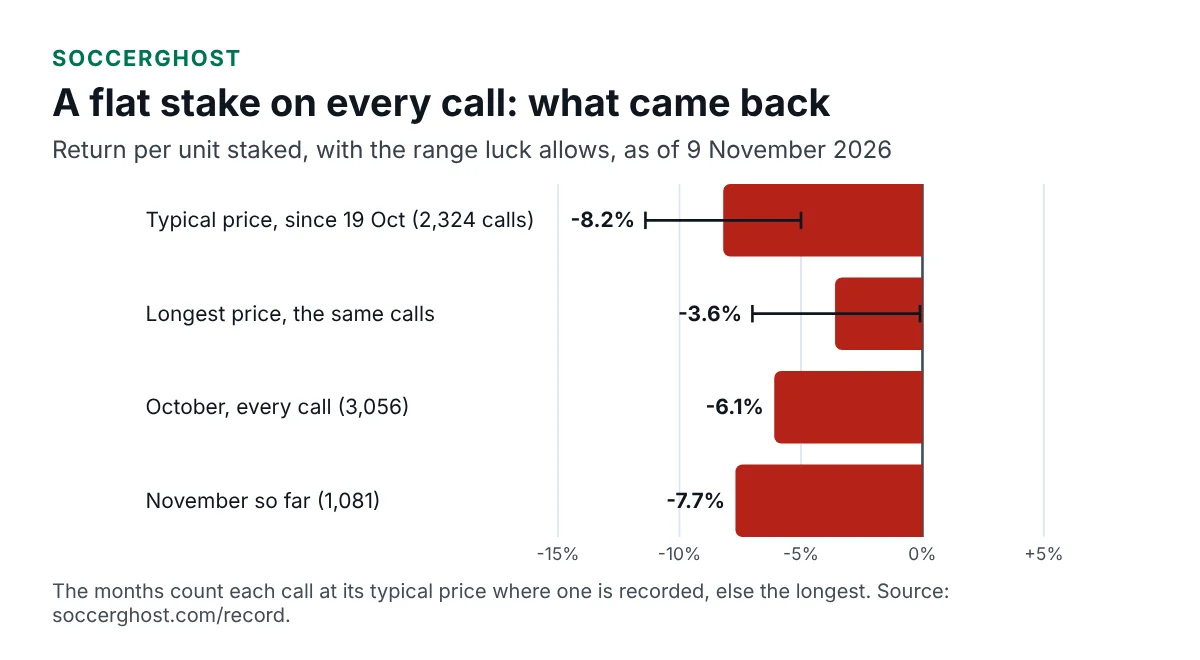
People ask whether following the Ghost makes money. The Ghost Record answers that on its front row, and the answer is no.
Here are the figures as of 9 November. Suppose you'd put the same stake on every call the Ghost committed since 19 October, 2,324 of them, each at a typical bookmaker's price at the moment it was published. You'd be down 8.2% of everything you staked. Luck could have moved that anywhere from −11.4% to −5.0%, so it isn't one bad week. Taking the longest price any checked bookmaker offered on each call does better, −3.6%, but it's still a loss.
That needs explaining. The Ghost's calls come in close to as often as it says. So where does the money go?
One call, worked through
Take Brighton v Brentford on 8 November. The Ghost's call was Brighton to win, at 50.9%.
A fair price for a 50.9% chance is one divided by it: 1.96. At 1.96, a bet that wins 50.9% of the time breaks even in the long run.
When the call was published, ten bookmakers were checked. The typical price, the one at least half of them paid or beat, was 1.91. The longest was 1.98.
Now suppose the Ghost's 50.9% was exactly right. At 1.91, every pound staked returns, on average, 0.509 × 1.91 = 0.972. That's a loss of 2.8p in the pound before anything else goes wrong. At 1.98 it comes to 1.008, a gain of 0.8p, but that needs the single best price on the market, every time, and a forecast that's exactly right.
Brighton won 2–0, so this one paid. That's one match. Over hundreds of calls, the gap between 1.91 and 1.96 is what decides it.
Where the money goes
The margin. A bookmaker's prices on a match add up to more than 100%. Turn each price into a chance (one divided by the price), add the home win, the draw and the away win, and the total comes to more than 100%. The extra is the bookmaker's cut, and it's built into every price, the typical one included. Brighton's typical 1.91 against a fair 1.96 is that cut at work.
The Ghost isn't exactly right. On single results, the market's fair prices have been more accurate than the Ghost's (see Is the market better than the Ghost?). Where the Ghost and the market disagree, the market has more often been closer. A forecast that is a little worse than the market's, bet at prices a little worse than fair, loses on both counts.
Timing. The return is worked out at the price on offer when the call was published, about five and a half hours before kick-off. The record also measures each call's price against the fair closing price, the market's last word with the margin taken out. At a typical price, the Ghost's calls came out 6.1% below it. That figure, the closing line value, is the one serious bettors watch most. Part of the gap is the margin and part is how the market moved after the call was published. Either way it says the same thing as the returns: the price you could have taken was worse than the market's own fair view at kick-off.
Why the record counts it this way
There are kinder ways to work out a return, and the record avoids them on purpose.
It doesn't settle at the closing price, which "would credit the Ghost for moves it predicted rather than beat", as the record page puts it. It shows the typical price beside the longest, because the longest is "a price no one reader holds at all of them". And it keeps every month, the bad ones included. October came out at −6.1% and November so far at −7.7%.
September shows +1.6%. We don't lead with that, and you shouldn't read much into it. The record only began keeping a typical price on 19 October, so September's return is counted at the longest price recorded, the most generous measure there is. On the same longest-price measure, the calls since 19 October come to −3.6%.
What it means
A forecaster can be well calibrated, its 70% calls coming in about 70% of the time, and still lose money at bookmakers' prices. Calibration is about saying the right chance. Making money needs a better chance than the bookmaker's, and a price that hasn't had the margin taken off. The Ghost has had neither, consistently.
That's why the site says, on every page that matters, that nothing on it makes betting pay. It isn't small print. It's the result.
If you bet, set a limit you're happy to lose, and stick to it. SoccerGhost takes no bets and holds no money. It is for adults, 18 or over, and if betting has stopped being fun, here is where to get help.