
Is the market better than the Ghost? Yes, and here's how we measure it
On 4,959 calls with a fair closing price, the bookmakers' prices have been more accurate than the Ghost's, by more than luck explains. This post explains the Brier score that measures it, works through two real calls, shows where the two are level and where they are not, and says why we publish the comparison at all.
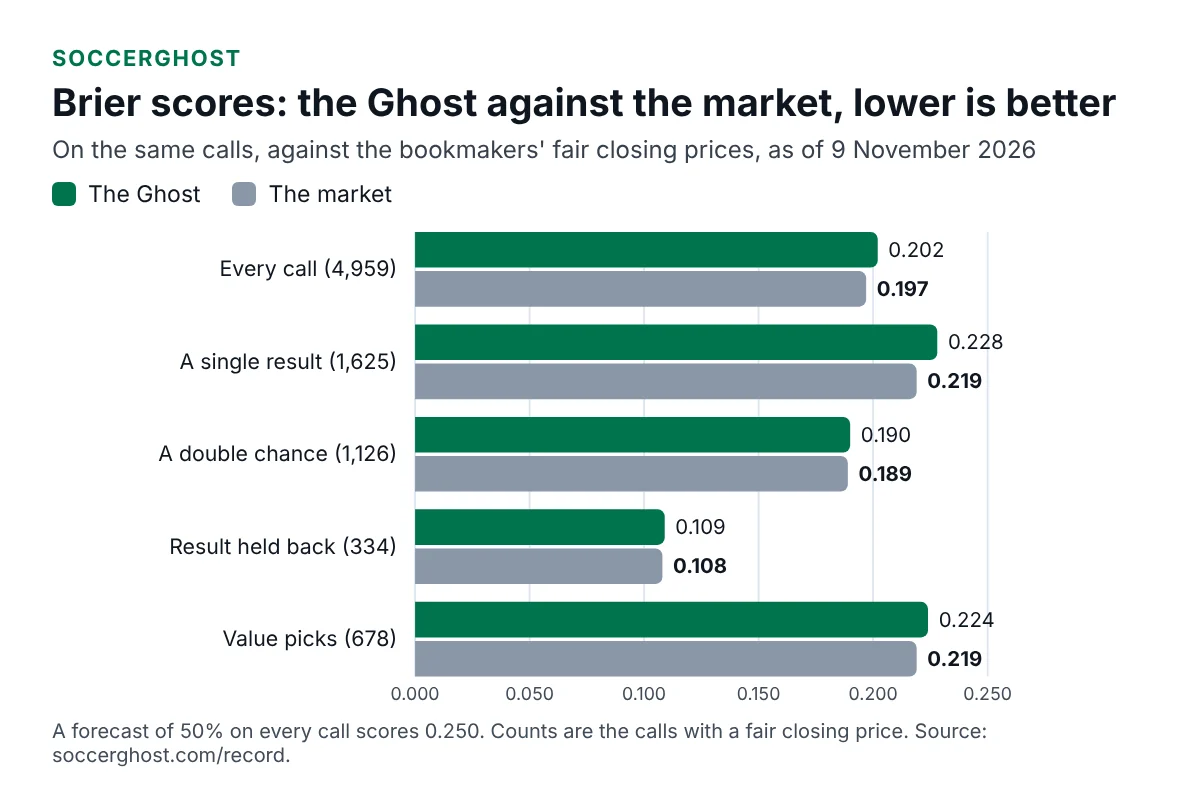
Most prediction sites never answer this question, so we'll answer it first. The bookmakers' prices have been better forecasters than the Ghost. On the 4,959 calls on the Ghost Record that have a fair closing price, the market's Brier score is 0.197 and the Ghost's is 0.202. Lower is better, and the record says the gap is "beyond what luck allows".
That isn't a surprise to us. Replayed over more than 35,000 past matches, the bookmakers' closing prices forecast the results better than the Ghost there too, and how the Ghost predicts says so in as many words. What's worth explaining is how the comparison works, where the gap is and where it isn't, and why a site would publish a number that makes it look second best.
The Brier score in one minute
A forecast says how likely something is. The Brier score asks how far that was from what happened.
For each call, take the chance the forecaster gave it. If the call came in, the outcome counts as 1. If it missed, 0. Square the difference. Then average those squares over every call. A perfect forecaster, 100% on everything that happened and 0% on everything that didn't, would score 0. A forecaster who said 50% on everything would score 0.250 every time, however things turned out.
Two calls from Sunday 8 November show the arithmetic:
- Brighton to beat Brentford, 51%. Brighton won 2–0. The miss distance is 1 − 0.51 = 0.49, and squared that's 0.240.
- Chelsea to win at Sunderland, 46%. Sunderland won 1–0. The distance is 0.46 − 0 = 0.46, and squared that's 0.212.
A call at 51% that comes in scores worse than a call at 46% that misses. That feels odd until you see what the score rewards. It rewards saying the right number, not just picking the right side. A 51% that comes in was barely better than a coin toss, and the score treats it that way.
The record works the same sum out for the market. Take each bookmaker's closing price, remove the margin, take the middle of the bookmakers, and you get the market's fair chance for the same call. Square its distances and average them. Same calls, same results, two scores.
Where the gap is
The chart above splits the calls the way the record does. The gap isn't spread evenly.
Single results are where the market is clearly ahead: 0.219 against 0.228, on 1,625 calls. Those are the calls where the Ghost names one result, such as "Brighton to win". They're also where the Ghost has been, oddly, too modest. It said 57% on average, and 60% came in. The market said 60%.
Double chances are level: 0.189 against 0.190. So are the held-back calls in another market (0.108 against 0.109) and the value picks (0.219 against 0.224, within luck). On these, the record says "no clear difference".
By model, the club model's calls trail the market by a clear margin (0.198 against 0.203), and so do the international model's, on far fewer calls (0.193 against 0.217, on 102). The European and domestic cup pools are level with the market so far.
It isn't a level contest, and that's on purpose
There's a detail that makes the comparison harder for the Ghost than it looks. The Ghost commits each call about five and a half hours before kick-off. In the week of 2 to 8 November, 699 of the 711 first calls on a match went in at least five hours early. The market's number is its closing price, just before kick-off.
In those last hours the market learns things the call couldn't: the confirmed elevens, late injuries, and the money of people who bet for a living. Team sheets and injury lists shows how much the elevens alone can move a forecast. Brighton's call, made at 08:30, was marked against a price set in the minutes before the 14:00 kick-off.
We could pick an easier benchmark: the opening price, or one bookmaker's price with its margin left in. The Ghost would look better. It wouldn't be a more honest test. The closing price is the hardest one there is, so it's the one we use.
So why use the Ghost at all?
Because it's a different opinion, reached a different way, and you can see all of its working.
The market's price is shaped by the bets people place. The Ghost's number is built from football alone: results, the chances sides create, the players named. Bookmaker prices never go into it. When the two agree, that's worth knowing. When they disagree, you're seeing two separate views, not one echoing the other. And with every call on a chain that can't be edited, you can check how often the Ghost's view has held up, band by band and month by month.
What the Ghost can't do is beat the bookmakers. We don't say it can. On single results the record shows it doesn't. If that changes, the record will show that too, at the same calls and the same prices, with nothing taken out.
SoccerGhost takes no bets and holds no money. Betting loses money on average, at the Ghost's numbers or anyone else's. The site is for adults, 18 or over, and if betting has stopped being fun, help is here.