
Rest days and the 'European hangover': what 188 rested sides showed
When one side has had three or more extra days off, the match page says so, and then says the Ghost leaves it out of the numbers. In the first week of November 188 sides had that kind of rest advantage. Here's what the Ghost expected of them, what they actually did, and why the tired-legs story is easier to believe than to find.
Manchester City won 3–2 away to RB Leipzig in the Champions League on Wednesday 4 November. Three days later they lost 3–1 at Nottingham Forest.
You know the story that gets told about a result like that. City were tired. Forest were fresh. It's the European hangover.
Forest's match page had noticed the gap: "Nottingham Forest has had 4 more days of rest." Then it added: "Measured: no effect the ratings miss." And in small letters: "Not in the numbers." The Ghost gave Forest a 25% chance and left the rest out.
That looks like the Ghost ignoring something obvious. So we checked a week's worth.
What the note says, and when it appears
When one side has had at least three more days of rest than the other, the match page flags it. It names the side and the number of extra days, and every time it says the same thing: measured, no effect that the ratings miss.
The wording matters. It doesn't say rest makes no difference to footballers. It says that when the effect was measured against the Ghost's ratings, there was nothing left over for the ratings to add. Whatever rest does, the ratings already seem to account for it.
188 rested sides
From 1 to 8 November, 188 sides had the flag. Most had three or four extra days, a few had a week or more.
The first thing to notice is who they were. On average the Ghost gave them a 30% chance of winning and a 46% chance of losing. The rested side was usually the weaker one, and that makes sense. The sides that play twice a week are mostly the ones in Europe or still in the cups, and they tend to be the stronger clubs. Rest and quality pull in opposite directions.
So the right question isn't whether rested sides won. It's whether they did better than the Ghost expected, given everything else it knew.
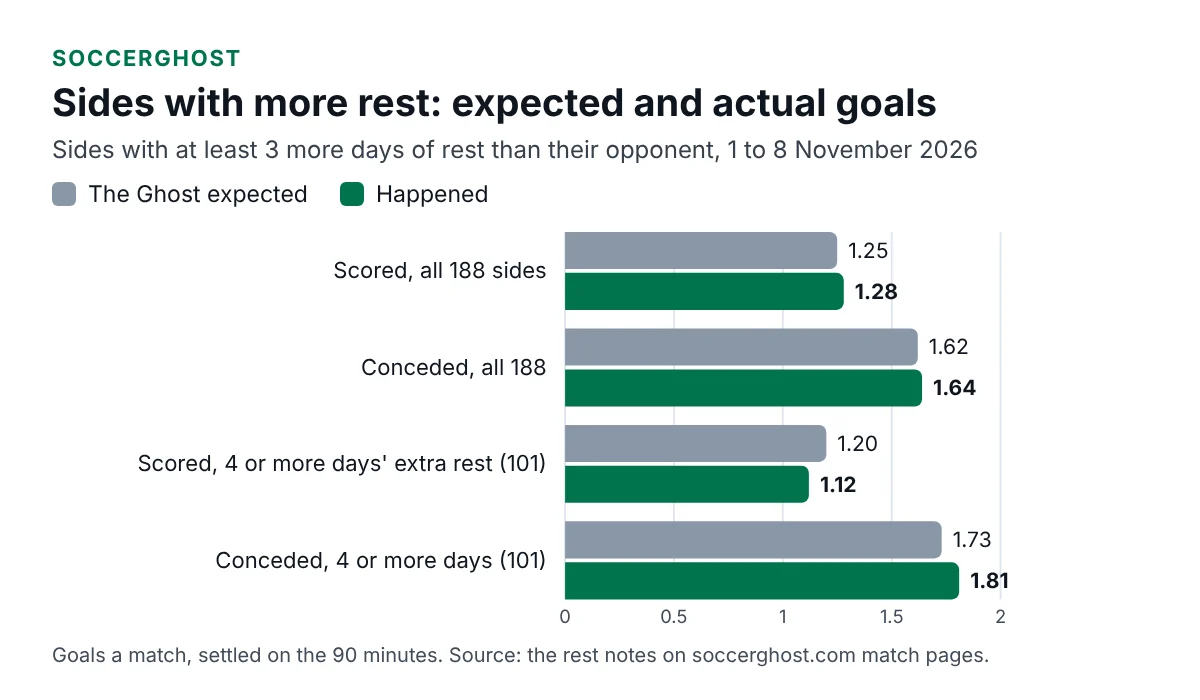
They didn't. The Ghost expected the 188 to score 1.25 goals a match and concede 1.62. They scored 1.28 and conceded 1.64. Their goal difference came in at −0.36 a match, against −0.37 expected. It's hard to get closer than that.
The 101 sides with four or more extra days did slightly worse than expected, not better: 1.12 goals scored against 1.20, and 1.81 conceded against 1.73. Over a hundred matches, a gap of under a tenth of a goal either way is well within luck. If there's a rest advantage hiding in there, it's too small for a week to find, and it doesn't point the way the hangover story says.
Why the hangover is easy to believe
Because the memorable matches are real. City did lose at Forest three days after Leipzig. Juventus played at AZ on the Thursday and drew 2–2 at Fiorentina on the Sunday, where the Ghost had them at 55%.
But the same week had the other kind too, and nobody calls those a hangover. Bayern München won 2–0 at Atlético Madrid on 3 November and 2–1 at Mainz on 7 November. Mainz had four more days of rest. Real Madrid had four more days than Racing Santander on 1 November, and won 3–0, and three fewer than Valencia on 7 November, and won 3–0 again.
When a tired favourite drops points, the tiredness gets the blame. When a tired favourite wins, nobody mentions it. Over a week, the two kinds even out, which is what the numbers above show.
Why the ratings already know
Part of the answer is that a side's ratings come from all its matches, including the ones played on short rest. A club that plays twice a week for a whole season has its rotation, its squad depth and its tired performances baked into its results. The ratings aren't describing a side at full rest. They're describing it as it actually plays.
The other part is the team sheet. When a coach rests players after a European night, the change shows up in the confirmed eleven, and once both elevens are out the Ghost marks a side down by how much of its usual strength it names. Rest that changes who plays is already counted that way. Team sheets and injury lists explains how.
What a week can and can't show
188 matches is enough to see that rested sides didn't run away from the Ghost's expectations. It isn't enough to rule out a small effect, a tenth of a goal a match, say, and it's one week in November rather than a season. The note's "measured" refers to the Ghost's own check on past matches. We've used one week to see whether it held, and it did.
It's the same pattern as the new-manager bounce: a story everyone can picture, flagged on the page so you know the Ghost has seen it, and left out of the numbers because, measured properly, it added nothing.
SoccerGhost takes no bets and holds no money, and it's only for adults, 18 or over. If betting stops being fun, help is here.