
Value picks: a better price, not a surer result
Since 4 October the Ghost has marked 678 value picks. It said half would come in, and 43% did, fewer than luck explains. Here is what a value pick actually is, why picks chosen this way tend to fall short of the Ghost's number, and what the site does when a market keeps falling short.
The value picks are the part of the record we are least happy with, so they are worth a post of their own.
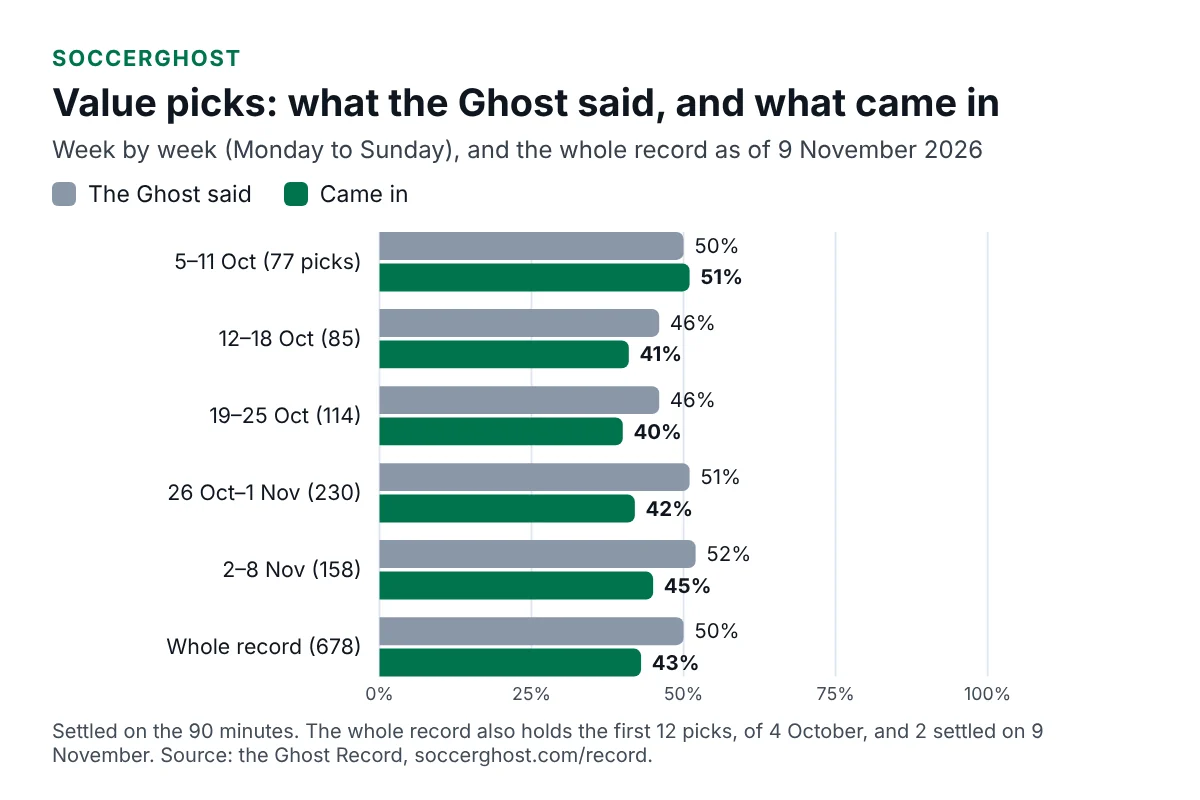
Since 4 October the Ghost has marked 678 of them. On average it said each had about a 50% chance. 43% came in. Over 678 picks, luck alone would put the rate somewhere between 39% and 47%, and 50% is outside that range. The Ghost Record says so in plain words: "fewer came in, beyond what luck allows". In the chart above, only the first week came in as often as the Ghost said.
So what is a value pick, and why does it miss more often than the Ghost says?
What a value pick is
It is not the Ghost's favourite bet. That is the card's call, one per match, judged separately.
A value pick starts with the bookmakers, not the Ghost. Each bookmaker prices a match with a margin built in. Take the margin out and line up several bookmakers, and the middle of them gives a fair chance for each outcome: the market's own view. Now and then one bookmaker pays noticeably more than that fair chance says it should. The markets page sets out exactly when SoccerGhost marks it:
- the bookmaker pays at least 2% over the market's own fair price, and its price was seen in the last two hours
- at least three bookmakers price that market
- the market gives the outcome at least a 20% chance
- at least two bookmakers offer it, and the longest price is no more than 25% above the next
- the Ghost's own number agrees the price is worth taking (it holds an under, or a "No", two points lower before it checks).
Read that list again and notice what is missing. Nowhere does it say the outcome is likely. A value pick is a statement about one price at one moment: this bookmaker is paying more than the others think it should. It lapses once the price is two hours old.
That is why the average value pick sits near 50% while the card's calls sit near 66%. They answer different questions.
Why they come in less often than said
The market's fair price, on those same 678 picks, said 45%. 43% came in. The market was close. The Ghost, at 50%, was too high.
That gap has a simple cause, and it is one we wrote about in Is the Ghost guessing?. The last condition on the list asks the Ghost to agree with the price. A pick only gets through where the Ghost rates the outcome higher than that long price implies. Some of those are cases where the Ghost has seen something real. Others are just the Ghost's ordinary errors, the matches where it happens to rate a side too high. A filter that keeps only the matches where the Ghost is keener than the market collects both, and the second kind drags the average down.
The low bands of the record show the same thing. Between 20% and 30%, the Ghost said 26% on average and 17% came in. In the week of 2 to 8 November, every call the Ghost made in that band was a value pick. Long prices, chosen because the Ghost liked them, missed more often than it said.
The price was real
There is a second half to this, and it is easy to get wrong.
The record also checks each pick's price against the fair closing price, the bookmakers' last view just before kick-off with the margin taken out. At the price the pick named, the value picks beat the close by 2.8% on average, across all 678. Over that many picks, luck allows from 2.3% to 3.2%. So the long prices were genuinely long. The bookmakers moved toward them by kick-off.
But that is the best price, at one bookmaker. At a typical price, the one at least half the checked bookmakers paid or beat, the same picks came out 9.0% short of the close, across the 502 where a typical price was recorded. Most readers bet at one or two bookmakers and will not get the longest price on every pick. And neither figure is a profit. The record's returns at a typical price, across every kind of call, are below zero.
That is what "a better price, not a surer result" means. A value pick can be right about the price and still lose more often than the Ghost said, and it has.
What the site does about it
A forecaster that keeps falling short in one place should get more careful there. SoccerGhost does this automatically, and shows it. The app's record has a panel called "What the Ghost has learnt", which says: "When a market's value picks come in less often than the Ghost said, beyond what luck explains, its next picks there must beat the price by more."
On 9 November it held back one market. The club model's value picks on a single team's goals: 50 picks, said 22.1 would come in, 12 did. Its next picks there are tested at ×0.81, so a price now has to clear a much higher bar before the Ghost agrees with it.
Not every short market is held back. The club model's value picks on the match result have come in 29 times in 111, against 36.4 said. That is short too, but not yet by more than luck explains, so the rule leaves it alone for now. We would rather the rule were strict and slow than move on every bad week.
How to read one
If you see a value mark on a match, read it like this. One bookmaker, right now, pays more than the market thinks the outcome is worth, and the Ghost does not dispute it. It is not a tip. It is not saying the outcome will happen. Over the record so far it has happened less than half the time.
The record keeps the value picks in a row of their own, apart from the card's calls, so they never flatter the Ghost or hide behind it. If that row turns around, it will show. If it doesn't, that will show too.
SoccerGhost takes no bets and holds no money, and nothing here makes betting pay. It is for adults, 18 or over. If betting stops being fun, there is help here.