
Late goals: one Ghost call in ten was decided after the 85th minute
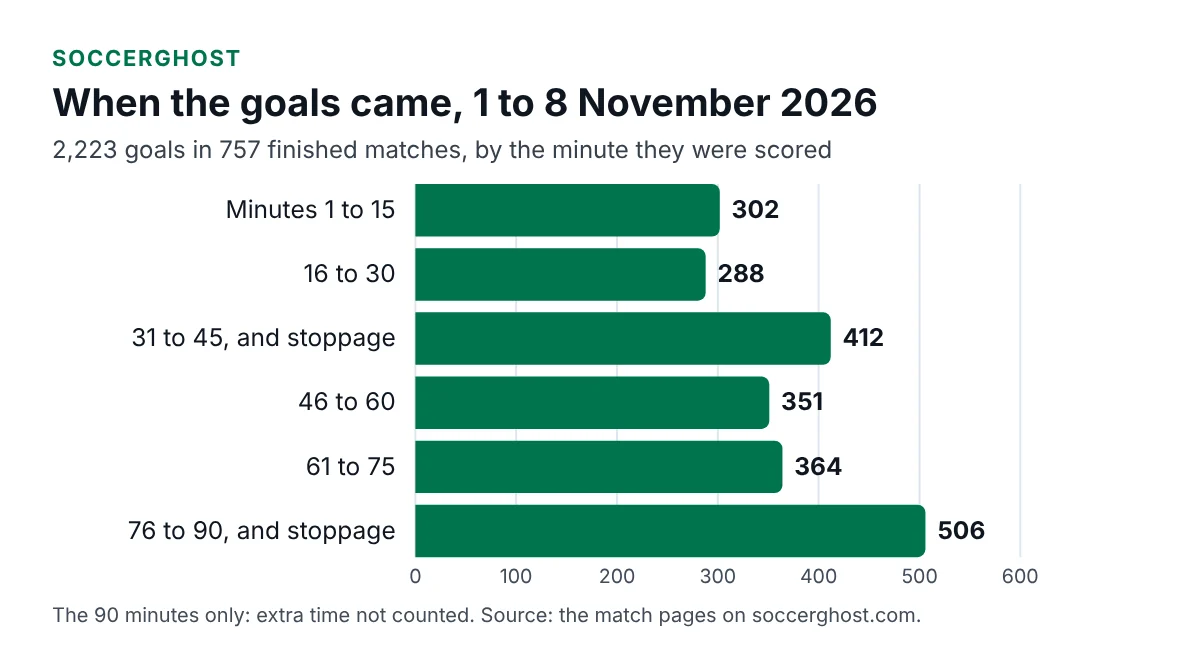
We went through the goals in 757 matches from the first week of November, minute by minute. More goals came in the last quarter of an hour than in any other, and 77 of the Ghost's 737 calls were settled by a goal scored after the 85th minute. Here's what that shows, and why most of those late goals went the Ghost's way.
Going into stoppage time at Old Trafford on 8 November, Aston Villa led Manchester United 4–2. The Ghost's call was that one side or the other would win, at 75%, and at that point it was coming in comfortably. Then Manchester United scored in the 92nd minute and again in the 96th. It finished 4–4, and the call went down as missed.
That match got us wondering how often the last few minutes decide a call. So we read the goals off every finished match page from 1 to 8 November and checked.
The last quarter of an hour
Of the 803 matches we saved, 757 had a full list of goals that matched their 90-minute score. Those 757 had 2,223 goals between them.
The chart above splits them by when they were scored. The last fifteen minutes, with stoppage time, had 506 goals, more than any other quarter of an hour and about 23% of the lot. The first fifteen minutes had 302. The period just before half-time looks busy too, but that's partly because first-half stoppage time is counted in it.
Narrow it further. 283 goals, about one in eight, came in the 85th minute or later. And 133, about one in sixteen, came in stoppage time at the end of the match.
How many results changed
In 116 of the 757 matches, about 15%, the result after 90 minutes wasn't the result at the 85th minute. A home win became a draw, a draw became an away win, and so on.
The draw was the shakiest place to be. 194 matches were level going into the 85th minute, and 82 of them, about four in ten, ended with a winner.
How many calls it decided
The Ghost made a call on 737 of those 757 matches. We worked out whether each call would have come in had the match stopped before the 85th minute, and compared that with how it actually settled.
77 calls changed, about one in ten. And they didn't change evenly: 57 turned from a miss into a win, and 20 went the other way. Overall, 534 of the 737 calls came in, 72%. Take away the late goals and it would have been 497, or 67%.
Most of the difference came from single results, the calls that name one side to win. There were 346 of them. 35 were turned into wins after the 85th minute and only 4 were turned into losses. A few examples:
- Boca Juniors were at 55% against Defensa y Justicia on 7 November. It was 0–0 until the 96th minute, when Boca scored.
- Real Madrid were at 64% away to AEK Athens in the Champions League on 4 November. It was 2–2 until the 92nd minute, and Real won 3–2.
- Twente v Ajax on 8 November went the other way. The call was that one side would win, at 78%. Ajax led 2–1 until a Twente penalty in the 95th minute made it 2–2, and the call missed.
Why late goals mostly helped
It's tempting to read 57 against 20 as the Ghost being lucky. We don't think it is, and the reason says something about how the calls are built.
Most calls back a side to win, or back one side or the other to win. For those calls, a level score late on is the worst place to be, and a goal is exactly what they need. Tired legs, substitutes, a side throwing everyone forward: whatever the reasons, more goals come late than at any other time, as the chart shows. So a late goal is more often one the call was waiting for than one it feared.
The calls that do fear late goals are the ones that back a draw in some form, such as "Gillingham or a draw", and the unders. There are far fewer of those, because a draw almost never reaches the 45% the Ghost needs to call a single result. One result or two explains the rule.
None of this was a windfall the Ghost didn't price. Its chances are for the whole 90 minutes, stoppage time included, and late goals are part of what those chances describe. A 55% on Boca already included every way Boca could win, a goal in the 96th minute among them. What the minute-by-minute view shows is where some of that 55% actually lives.
The 90 minutes, and nothing after
One rule matters here. Every call settles on the 90-minute score, stoppage time included, and nothing after it. Extra time and penalties never count, which is how bookmakers settle these markets too. The markets page gives the example of a cup tie that's 1–1 after ninety minutes and won 2–1 in extra time: it settles as 1–1.
So a goal in the 96th minute counts in full. A goal in the 96th minute of a cup tie's extra time doesn't count at all.
A week isn't a season
This is one week of football, and the split between late wins and late losses could look different over a season. The big numbers here, one goal in eight after the 85th minute and four in ten late draws broken, rest on hundreds of matches. The small ones, like 35 late wins against 4 late losses on single results, rest on far fewer.
The useful lesson is simpler than any of the numbers. A match isn't settled at the 85th minute, and a 4–2 lead in stoppage time isn't safe either. The record settles at the final whistle of normal time, and so should anyone reading it.
SoccerGhost takes no bets and holds no money. It's for adults, 18 or over. If betting stops being fun, help is here.