
The new-manager bounce: what 1,050 coaching changes showed
Sack the manager and results pick up. Football believes it, and the results often seem to agree. SoccerGhost measured 1,050 coaching changes against what its ratings expected, and found no bounce the ratings miss. Here is what that means, why the bounce looks real anyway, and why the Ghost flags a new coach but leaves it out of the numbers.
Every season it happens somewhere. A side loses five in a row, the manager goes, and the new one wins the first two. The papers call it a bounce, and next time a club is struggling, everyone asks when it will make the change.
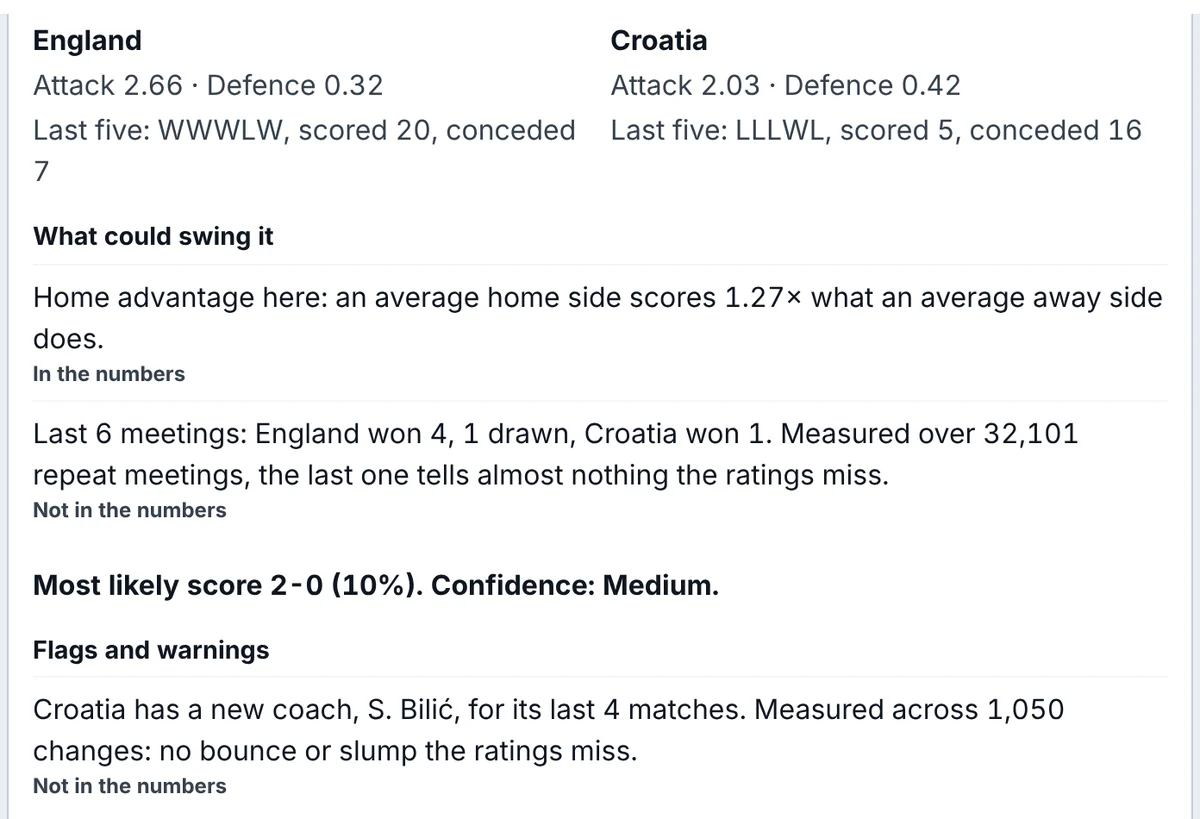
Look at the match page for England v Croatia this week and you'll see the Ghost has noticed Croatia's new coach. It just doesn't do anything about it. The flag reads: "Croatia has a new coach, S. Bilić, for its last 4 matches. Measured across 1,050 changes: no bounce or slump the ratings miss." Then, in small letters: "Not in the numbers."
Here's what that measurement was, and why a bounce that seems so obvious from the stands disappears when you test it properly.
What was measured
SoccerGhost took 1,050 coaching changes in the club competitions it covers and looked at the ten matches after each one. For every match, it compared what the side actually scored and conceded with what its ratings expected before the match was played. That is the key part: not "did results improve?", but "did results beat what the Ghost already expected?"
In those ten matches, sides with a new coach scored and conceded within about two hundredths of a goal a match of what their ratings said. Every side in every match drifts from its ratings by about that much. So a side with a new coach did no better and no worse than the ratings expected. The last check was on 27 September 2026.
That's why it says "no bounce or slump the ratings miss" rather than "no bounce". The difference is important.
Why the bounce looks real
The bounce people see is mostly a side returning to its normal level after a bad spell.
Think about when managers get sacked. Hardly ever after a good run. Almost always after a bad one: a string of defeats, often worse than the squad deserves. Some of that run is real decline. A lot of it is ordinary bad luck. Shots hit the post, a penalty is missed, a deflection goes in. Football has so few goals that a run of five bad results can come from a side that's playing reasonably well.
Luck doesn't carry over. Whatever happens in the dugout, the next five matches are likely to go better than the last five, simply because the last five were unusually bad. If the club changed its manager in between, the new manager gets the credit.
Statisticians call this regression to the mean. You can see the same thing in other places: a side that changes its kit after a bad run, or a manager who keeps the job but "has a word" with the players, will also tend to improve.
Why the ratings already know
The Ghost's ratings don't overreact to a bad run. Each side's rating comes from three years of results, with the most recent counting most, blended with the chances it has created and allowed. Five bad results move it a little, not a lot. So when results pick up after a sacking, they're picking up toward where the ratings already had the side. Measured against the bad run, it's a bounce. Measured against the ratings, it's nothing.
And if a new coach really does change a side, the ratings catch it. Every finished match moves them, so a genuine improvement shows up in the numbers within a few games, without anyone having to guess at it in advance. Since 27 September recent form moves the numbers a little too, where it has been measured to help.
What the study doesn't say
It doesn't say managers don't matter. Over a season or two, the right appointment can transform a club, and the wrong one can sink it. The ratings will show that as it happens.
It doesn't say every new manager does nothing in the first ten games. Some do better than expected and some do worse. The study says those cases cancel out. On average, across 1,050 changes, there's no effect left over that the ratings miss. Anyone claiming a particular new coach will produce a bounce is making a call the evidence doesn't support.
And it's an average over the competitions SoccerGhost covers, from the top leagues to much smaller ones. It can't rule out an effect in one league that is diluted by the rest.
Why flag it at all, then?
Because you'll want to know, and because the match page should be honest about what the Ghost does and doesn't use. A new coach is on the list of things the page mentions and marks "Not in the numbers", along with the last few meetings between the two sides and a long rest for one of them. Each was measured and found to add nothing the ratings don't already know. A final and a derby are flagged too. Those weren't measured, so they don't move the numbers either.
So when you see the flag, read it as a heads-up, not a tip. The Ghost has noticed. It just has good reason not to change its numbers because of it.
SoccerGhost takes no bets and holds no money. It is for adults, 18 or over. If betting stops being fun, help is here.