
"No Pick": when the Ghost says nothing, and when it says something else
On Saturday 7 November, 188 matches finished and the Ghost had a call on the record for 183 of them. A match can go without a call for a few plain reasons, and a result call can be held back when the bookmakers rate it well below the Ghost. Here is each case, where the site says which one applies, and how the held-back calls have come in.
Open the app on a busy Saturday and most rows carry a call from the Ghost. A few say "No Pick" instead. People sometimes read that as the Ghost not being sure enough to commit. That is not what it means, and the real reasons are more useful to know.
Take Saturday 7 November. The results page for that day lists 188 matches. The Ghost had a call on the record for 183 of them: 126 came in, where the Ghost had said 121.4 would. The other five had no call at all: UCD v Drogheda United in Ireland, and four ties in Egypt's cup, among them Al Ahly v El Seka El Hadid and Pyramids v El Dakhleya.
Five out of 188 is a small share, but each of them has a reason. There are three kinds.
1. The Ghost has no forecast for the match
The Ghost rates a side from how it has done against the sides it has played. For that it needs enough matches, against opponents it can compare. When it doesn't have them, it doesn't guess. The match page says which reason applies, before kick-off, in one of a few fixed sentences:
- "The Ghost doesn't cover this competition yet, so it doesn't rate this match."
- "The Ghost prices a match in the week before kickoff, once the latest results are in." That one only means it is too early.
- "Too little history." The page then gives the count, for example how many of the league matches it needs from the last three years a side has actually played. A newly promoted side is the usual case.
- For a whole competition whose sides rarely meet each other, it says that the Ghost "rates sides by how they do against each other, which needs sides that meet again and again", and gives the numbers.
Once a match has been played without a forecast, the page says simply: "The Ghost didn't rate this match before kickoff." That is what the five matches of 7 November say now.
We think this is the right way round. A number on every match would look more complete and be worse. A forecast for a side the model has barely seen is a guess dressed up as a percentage, and the record would carry it like any other call.
2. The bookmakers disagree with the result call
The second case is the interesting one.
When the Ghost's likeliest result reaches 45%, that result is normally its call. When no result reaches 45%, the call is the double chance that leaves out the least likely result. One result or two explains that rule.
There is one more check before a result call goes on the record. If the bookmakers, with their margin taken out, rate it more than two points lower than the Ghost does, the call is held back. The Ghost doesn't overrule the market on the result. It calls another market instead: the likeliest one with a best checked price of 1.20 or more that the bookmakers rate no more than two points lower. The markets page states the rule in full.
Two matches from the past week show what that looks like.
Crystal Palace v Hoffenheim, Europa League, 5 November. The Ghost gave Palace 63%. That would normally be the call. The bookmakers rated Palace more than two points lower, so the result call was held back, and the call on the record became under 4.5 goals, at 74%. It finished 1–1, and the call came in.
Mjällby v Kalmar, Allsvenskan, 2 November. The Ghost had Mjällby at 48%, over the 45% line. Held back again. The call on the record became over 0.5 goals, at 92%: just one goal, by anyone. It finished 0–0, and the call missed. Its page also carries a warning under the forecast: "The Ghost and the market disagree sharply here. Where they have, the result has sided with the market more often than with the Ghost."
So "held back" doesn't mean safe. It means the Ghost has moved its call to a market where it and the bookmakers broadly agree.
3. Nothing to pick in its place
Sometimes the result call is held back and no other market is priced at 1.20 or more yet. That row says "No Pick", and its (i) says why: "The market disagrees with the result call, and no other market is priced to pick from yet."
And sometimes other markets are priced, but the bookmakers rate every one of them more than two points lower than the Ghost does. Then the one they disagree with least is called anyway, marked low confidence, with the market's own number shown beside it. Since 1 October that has happened exactly once, at 77%, and it missed.
How the held-back calls have done
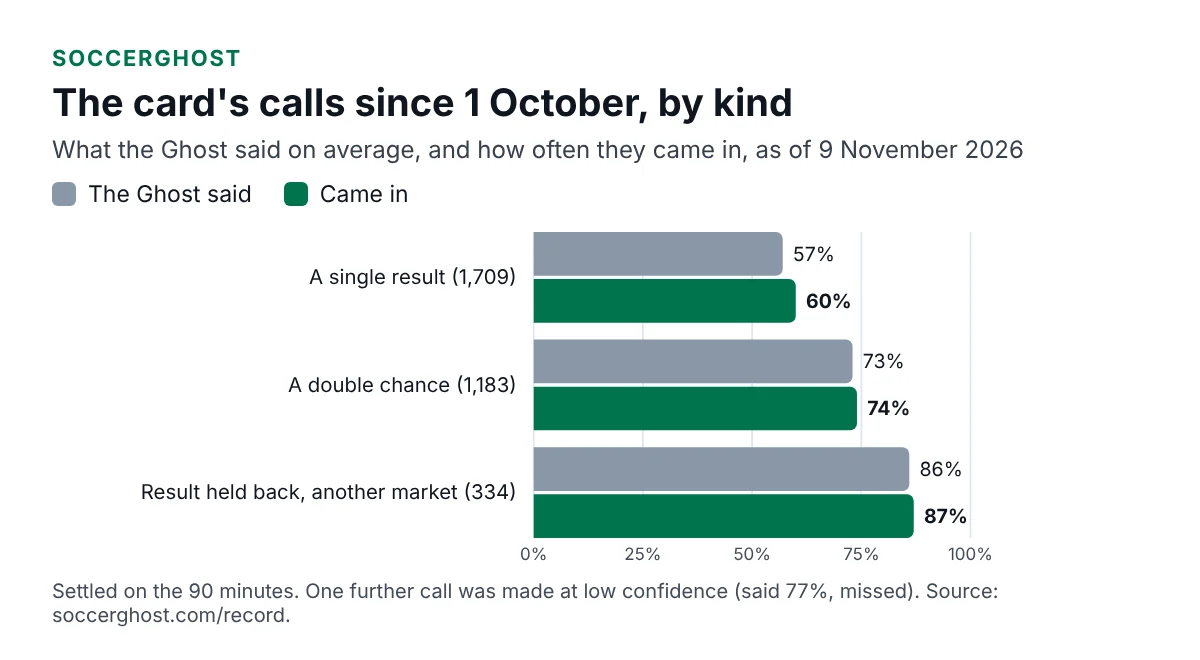
The chart at the top splits the card's calls since 1 October by kind. The held-back calls are their own row on the Ghost Record: 334 settled, said 86% on average, 87% came in. The market's fair prices said 87% on the same calls, and their Brier scores, 0.109 for the Ghost and 0.108 for the market, show no clear difference.
They come in more often than the single results simply because they are called at higher chances. Under 4.5 goals is a likelier thing than a Palace win. That is why the record never mixes them with the single results or the double chances. A rate of 87% says nothing about skill unless you know the chance it was called at.
In the week of 2 to 8 November, 154 of the 705 card's calls were held-back calls in another market. 125 came in, against 78.6% said, within what luck allows.
What a match without a call is not
It isn't on the record. The record holds calls, not matches, and a match with no call adds nothing to it, neither a win nor a loss. The five matches of 7 November are not hidden losses. They simply aren't there, and each one's page says that the Ghost did not rate it.
And it isn't the Ghost passing on a hard match to protect its numbers. Close matches get a call too: a double chance, which the record keeps in a row of its own so it can't flatter the rest.
SoccerGhost takes no bets and holds no money. Every call above, the misses included, is on the record. The site is for adults, 18 or over, and if betting has stopped being fun, help is here.