
One result or two: how the Ghost chooses between a single result and a double chance
Every match has three possible results, and the Ghost gives each a chance. Where one reaches 45%, its call names that result. Where none does, it names the two likeliest together, a double chance. Here is the rule, two matches from 8 November that show it, why the draw is the result most often left out, and how both kinds of call have come in on the record.
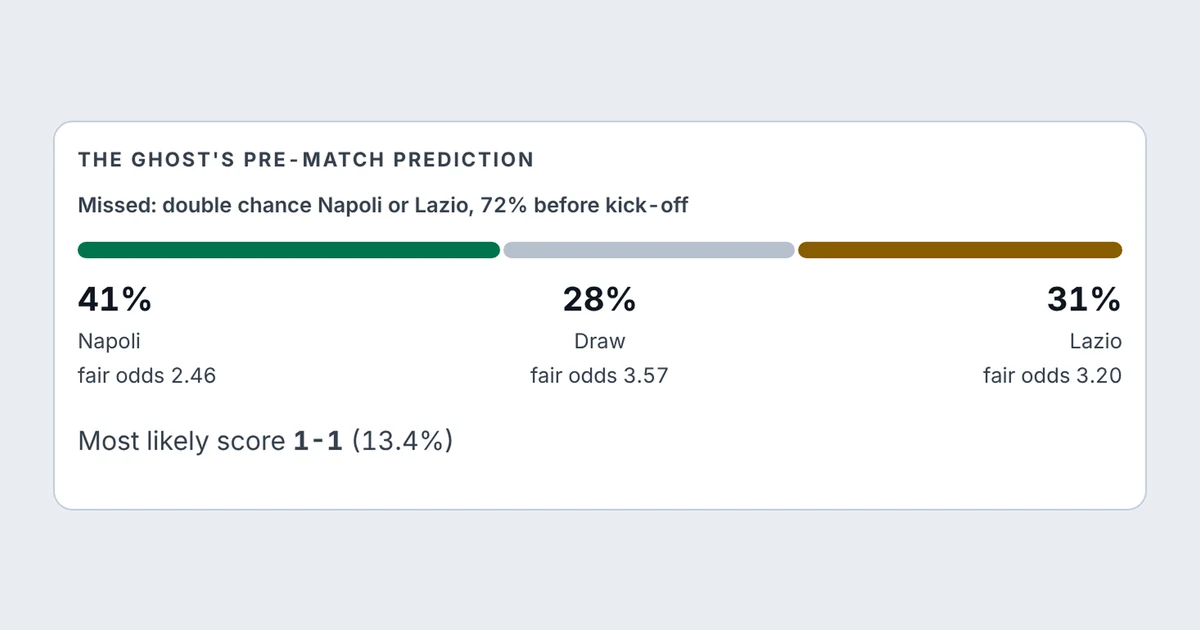
Napoli v Lazio on Sunday 8 November was close enough that the Ghost wouldn't pick a winner. Its call was "Napoli or Lazio", at 72%. The match finished 1–1, the one result the call left out.
Every match ends one of three ways: a home win, a draw or an away win, written 1, X and 2 on a betting slip. The Ghost gives each a chance, the three add up to 100%, and from those three numbers it makes one call. Here's how it decides what that call is.
Three results, three chances
Napoli v Lazio is the example in the picture above. Before kick-off the Ghost gave Napoli 41%, the draw 28% and Lazio 31%.
Beside each chance the page shows its fair odds: one divided by the chance. Napoli's fair odds of 2.46 are one divided by its chance before rounding, a shade under 41%. These are the odds at which a bet on that result would break even in the long run if the Ghost's chance were exactly right. A bookmaker's prices for the same match are shorter than fair, because they carry a margin. How to read a Ghost call shows that arithmetic step by step.
The chances come from football alone: each side's attacking and defensive ratings, the chances it creates and allows, its recent form and, once they're confirmed, the elevens. No bookmaker's price goes into them. How the Ghost predicts sets out the method.
The 45% line
Here's the rule the match card follows, as the markets page states it:
- Where the likeliest result reaches 45%, the call is that result. "Brighton to win" at 51% is a single result.
- Where no result reaches 45%, the match is too close for one. The call is then the double chance that covers the two likeliest results and leaves out the least likely one.
Napoli at 41% was the likeliest of the three, but short of 45%. So the call left out the least likely result, the draw at 28%, and named the other two together: "Napoli or Lazio", at 41% plus 31%, which is 72%.
The 45% line is a choice about how to present a close match, not a measure of skill. A double chance covers two results of three, so it comes in more often by its nature, and its odds are shorter for the same reason. That's why the record never mixes the two kinds of call.
What happened
Napoli and Lazio drew 1–1, and the double chance lost on the one result it left out.
There's a detail in the picture worth a second look. The draw was the least likely of the three results, at 28%. Yet the likeliest single score was 1–1, at 13.4%. Both are true at once. A draw can happen only as 0–0, 1–1, 2–2 and so on, so its 28% is shared among a few scores. A Napoli win is spread across many more: 1–0, 2–0, 2–1, 3–1 and the rest. No single winning score is as likely as 1–1, but together they add up to more.
The same afternoon showed single results going both ways. Brighton, called to win at 51%, beat Brentford 2–0. Chelsea, called to win at Sunderland at 46%, lost 1–0. A 46% call is expected to miss more often than it lands. Neither result says much on its own. Only hundreds of such calls do.
Why the draw is the one left out
On the record, the double chance usually leaves out the draw. In the week of 2 to 8 November about four in five of the double chances that settled were "either side to win". The rest were split between "home side or draw" and "away side or draw".
That follows from how rarely a draw is the likeliest result. When the club model's settings of 17 October were checked on 10,201 matches from January to October 2026, its draw chances averaged 25.75%, against 25.8% of those matches drawn, as the method page records. In a close match the two sides' chances usually sit above that, so the draw is the smallest of the three. Where one side is weak, its win can fall below the draw instead, and the call becomes "the other side or draw".
How both kinds of call have come in
A call is judged against what it said, never against the other kind. The Ghost Record, as of 9 November 2026, splits them:
| The card's call, since 1 October | Settled | Came in | The Ghost said | The market said |
|---|---|---|---|---|
| A single result | 1,709 | 60% | 57% | 60%, on 1,625 |
| A double chance | 1,183 | 74% | 73% | 73%, on 1,126 |
The single results have come in more often than the Ghost said, by more than luck allows. On its single calls it has been a little too unsure. The bookmakers' fair prices, with their margin taken out, said 60% on the same calls, and their Brier score, a measure of accuracy where lower is better, was 0.219 against the Ghost's 0.228. On single results the market has been the more accurate.
The double chances came in close to what the Ghost said, and the market's prices were no more accurate on them.
One week behaves the same way. In the week of 2 to 8 November, 327 single calls settled and 64% came in, against 57% said. 223 double chances settled and 71% came in, against 73% said.
Two results out of three, and still a miss
A double chance at 72% still misses more than one match in four, as Napoli v Lazio did. The call is the Ghost's reading of a close match, never a recommendation to bet on it, and the record has shown the market to be the sharper judge of single results. SoccerGhost takes no bets and holds no money. It is for adults, 18 or over, and if betting stops being fun, help is here.