
Low, Medium, High: what the Ghost's confidence label tells you
Every match page rates its own call Low, Medium or High confidence. The label isn't a second probability. It says how far to trust the number. In the first week of November the calls marked Low came in most often of all, and the reason says a lot about the Ghost and the bookmakers.
On 1 November the Ghost had Real Madrid at 65% to win at Racing Santander, and it called it. The match page marked that call "Low confidence", with a sentence underneath: "The Ghost and the market disagree sharply here. Where they have, the result has sided with the market more often than with the Ghost."
The bookmakers had Real Madrid a lot shorter. Even the longest price on offer when the call was made, 1.26, works out at about 79%. Real Madrid won 3–0.
That one match is a fair summary of what the label does, and of what it doesn't.
The number and the label are different things
A 70% chance from a model fitted on nine matches and a 70% chance from one fitted on three hundred are the same number. They aren't the same claim. The first is a rough guess that happens to land on 70. The second has a lot behind it. A page that shows only the number can't tell you which one you're looking at.
So every call gets a label as well, and the label always comes with its reason in words. Roughly, it works like this:
- High means the competition's ratings rest on at least 300 matches and the Ghost's chance is within four points of what the bookmakers' prices imply.
- Medium is most things in between. A big base of matches with no price to compare against is Medium, and the page says "with no market price to check against".
- Low means one of three things. The competition's ratings rest on too few matches, the model's run didn't pass its own reliability check, or the Ghost and the market are more than ten points apart.
The last part is worth stating plainly, because SoccerGhost says no bookmaker's price goes into a forecast. That's still true. A price can change the label beside a number. It never changes the number. The 65% on Real Madrid stayed 65% whatever the bookmakers thought.
Why agreement counts
When the Ghost and the market land close together, two separate estimates have reached the same place. The Ghost works from results and chances. The market works from prices, with everything bettors know or believe priced in. Agreement between them is evidence, so it nudges the label up.
When they're far apart, one of them is wrong about this match, and the record says which has usually been closer. On the 4,959 calls the bookmakers priced at the close, as of 9 November, the market's Brier score was 0.197 against the Ghost's 0.202 (lower is better). Is the market better than the Ghost? goes through that comparison. So a sharp disagreement gets a Low, and the sentence tells you which way the evidence has leaned.
What the first week of November showed
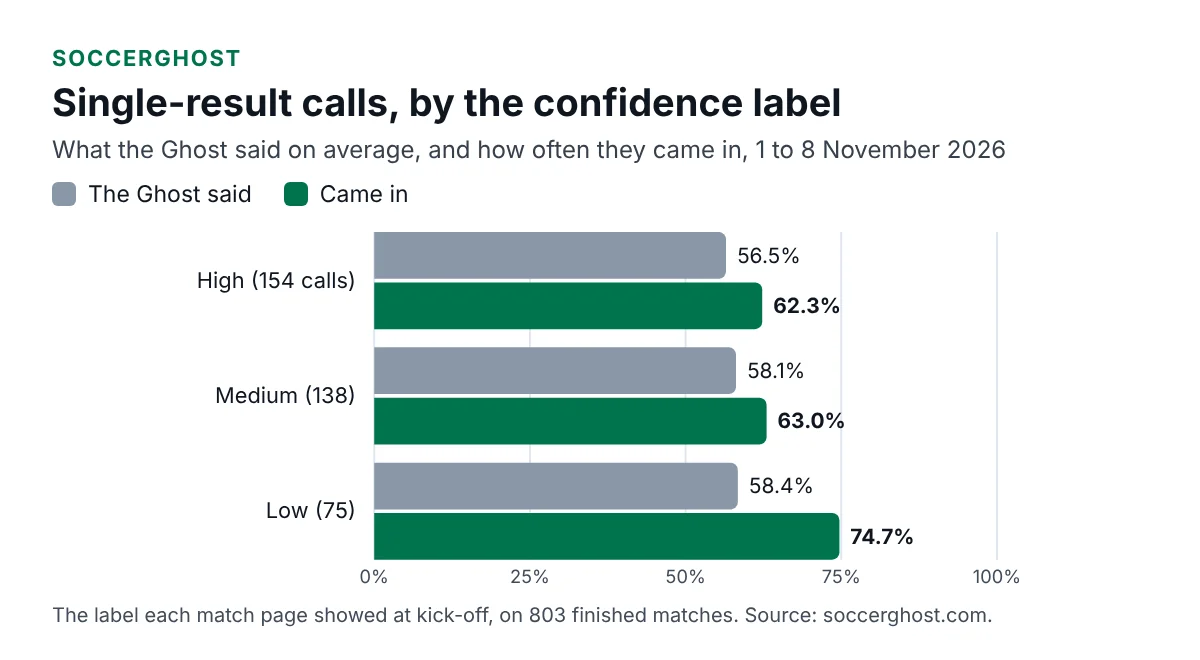
We read the label off all 803 finished match pages from 1 to 8 November and put it beside the Ghost's single-result calls (the ones that name one winner). The chart above has the result.
The High and Medium calls behaved about as you'd expect from the record as a whole. They came in five or six points more often than the Ghost said, which matches the record's long run: since 1 October, single results have come in 60% of the time against 57% said.
The Low calls were different. The Ghost said 58% on average, and 75% came in.
That looks backwards until you check which way the disagreement went. On 71 of the 75 Low calls, a price was recorded when the call was made. On every one of those 71, the bookmakers rated the Ghost's pick more likely than the Ghost did. Even taking the longest price on offer each time, which makes the market look as unconfident as possible, the prices implied about 72% on average. The results came in close to the market's view, not the Ghost's.
Real Madrid were one of those. So were Arsenal at home to Hull City on 7 November: the Ghost said 72% when it made its call, and the longest price, 1.18, implied about 85%. Arsenal won 1–0. It doesn't always go that way. Bayer Leverkusen were at 61% against Marseille in the Europa League, with the bookmakers nearer 74%, and lost 1–0.
What Low means, then
Low doesn't mean "this call is unlikely". It means "don't lean on this number". In that week, on these matches, the Ghost's number was too low, and the label and its sentence said so before kick-off.
It also doesn't mean the Low calls were a bargain. The bookmakers had already priced these sides as heavy favourites. Real Madrid at 1.26 or Arsenal at 1.18 paid very little, because the market knew what the results then showed. A label that agrees with the market can't find you a price the market got wrong.
Two cautions. This is one week, 75 calls, and a pattern that strong in a small sample can shrink a lot over a season. And the labels here are the ones the match pages show, which can be later than the call itself, after the team news. The Ghost Record keeps the long view, and it's the place to check whether the Ghost's favourites keep coming in more often than it says.
How to use it
When you read a match page, look at the label's sentence as well as the label. "Fitted on only so many matches, too few to be confident" and "the Ghost and the market disagree sharply" are both Low, for very different reasons. The first says the Ghost hasn't seen enough of these sides. The second says it has a view, and the record suggests trusting the market's over it.
How to read a Ghost call covers the rest of the page.
SoccerGhost takes no bets and holds no money, and it's only for adults, 18 or over. If betting stops being fun, help is here.