
Twelve versions in seven weeks: every change to the Ghost, including the one we rolled back
The Ghost's club model has changed eleven times since its first call on 24 September, and a twelfth version ran for 29 minutes before it was rolled back. Here is what each change fixed, how changes are tested before they go live, and why the calls the older versions made stay on the record exactly as they were.
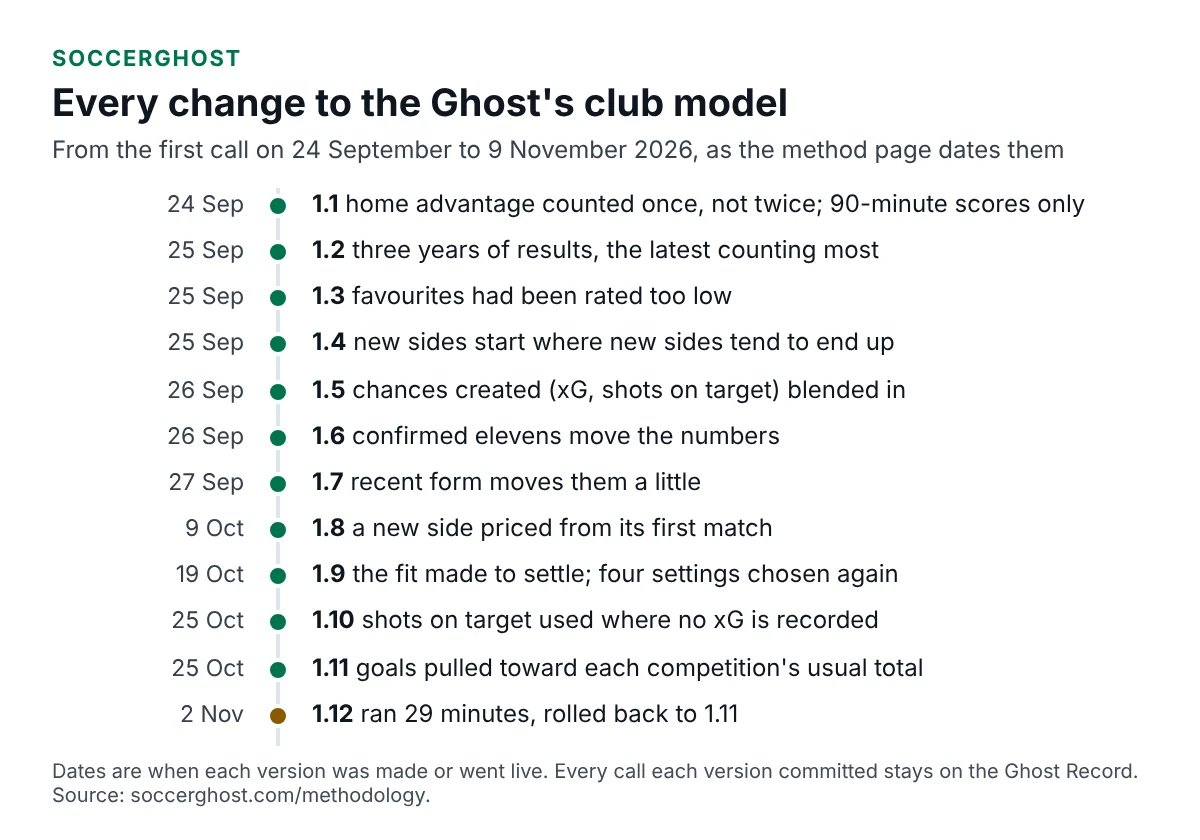
There's a version name at the top of how the Ghost predicts: dixon-coles-1.11. The ".11" is the eleventh change to the club model since the Ghost made its first call on 24 September. A twelfth didn't last the afternoon.
A forecaster that changes this often can look like one that doesn't know what it's doing. We'd put it the other way round. A new model meets real matches and turns up problems a replay didn't show. The choice is between fixing them in the open or leaving them in place. Here is every change, roughly in the order the problems turned up.
The first week: things that were simply wrong
1.1, 24 September. The very first version counted home advantage twice. Every call made under 1.0 leaned toward the home side by a whole extra home advantage. That was a plain bug, and it was fixed on day one. The same change made sure the model only ever learns from 90-minute scores, never from extra time or awarded results, and stopped it forecasting competitions that aren't a closed pool of teams. Those 1.0 calls are still on the Ghost Record, leaning toward the home side just as they did.
1.2 to 1.4, 25 September. Three fixes in one day. The model moved to three years of results instead of two, with the most recent counting most. Favourites had been rated too low, so the split between home win, draw and away win was sharpened. And a newly promoted side now starts where promoted sides have tended to end up, rather than at the league average, because promoted sides are usually weaker than average.
1.5 to 1.7, 26 and 27 September. These weren't fixes so much as the model starting to see more. From 1.5, a side's rating is blended with the chances it creates and allows: expected goals where the competition records them, and shots on target. From 1.6, once both elevens are confirmed, a side missing its regulars is marked down by how much of its usual strength it names. Team sheets and injury lists shows what that does in the last hour. From 1.7, recent form moves the numbers a little, where both sides have played five matches.
October: slower, more careful changes
1.8, 9 October. A side new to its competition is priced from its very first match there, at the level newcomers have been measured at. Before, the Ghost said nothing until it had six matches to go on.
1.9, 19 October. This one was found by checking the maths rather than the results. Replayed, 15.7% of the rating fits had stopped at the limit of 60 passes while still moving. In plain terms, the model had sometimes stopped calculating before it reached an answer. Under 1.9 none do. Four settings were chosen again together from 24 combinations tried. One check stands out: on 10,201 matches from January to October 2026, the draw chances averaged 25.75%, against 25.8% of those matches drawn. Before, they had averaged 27.1%.
1.10, 25 October. Most competitions don't record expected goals. Until 1.10, those were priced on goals alone, even though they do record shots on target. Now the shots are blended in. Replayed on 20,245 matches from 21 such competitions, the result chances were better in 20 of them.
1.11, 25 October. The ratings had rated low-scoring matches too low on goals, so the Ghost's strongest "under 2.5" calls came in least often, and home wins were said about one and a half points more often than they happened. Each match's expected goals are now pulled a quarter of the way back toward its competition's usual total, and the home side's share eased by 2%. Checked on 28,967 matches the settings weren't chosen on, it was a little better on the result and the goal lines, in 29 of 38 competitions.
The one that didn't stay
1.12, 2 November. It went live at 15:15 UTC. By 15:44 it had been rolled back to 1.11.
What it did differently was visible at once. Of the 55 club matches still to come, it held back the result call on 24, where 1.11 had held back 10. (A result call is held back when the bookmakers rate it well below the Ghost. No Pick explains.) A change that more than doubles how often the card steps away from the result is a big change, and we weren't willing to run it on the record without understanding it.
Three calls went out in those 29 minutes. They are still on the record, as published. We'd rather undo a change in half an hour and leave a note about it than defend it for a month.
How a change is tested
Every change is replayed walk-forward against the version it would replace. The model is run through past seasons as if it were live, rating each week only from the matches before it, and judged on matches its settings weren't chosen on. The method page gives the result of each, with the range luck allows, including where a gain sat inside that range.
A replay is the best case, though. The settings were picked knowing how past seasons went, even when they're checked on matches held apart. The real test is the record, where every call is committed before kick-off. That's why the record shows each model's calls apart, beside the market's prices on the same calls.
What doesn't change
Every call keeps the version that made it. Each line of the record even names the run of the model that produced it (see checking a call yourself). When the model improves, the old calls don't get quietly re-scored with the new one. The home-leaning calls of 24 September, the strong "unders" that came in too rarely, the three calls of 1.12: all of them count, at the numbers they were made at.
Some things haven't changed at all. No version has ever used a bookmaker's price as an input. Each one is still worse than the market's closing prices at forecasting results, replayed over more than 35,000 matches, and the record so far agrees.
SoccerGhost takes no bets and holds no money, and no version of the Ghost makes betting pay. It's for adults, 18 or over. If betting stops being fun, here is where to get help.