
Don't take our word for it: checking one of the Ghost's calls yourself
Every call on the Ghost Record is chained to the one before it, so a number can't be changed after the result without breaking everything that follows. This post follows one call, Brighton to beat Brentford on 8 November, from the moment it was committed to its result, and shows how to check its hash with one line on your own computer. It also says what the chain can't prove.
Any tipster can show you a list of winners. The hard part is showing that the list wasn't put together after the matches were played. Did they really say 70% before kick-off, or did the number creep up once the result was in? Were the losing tips there at all?
The Ghost Record is built so that you don't have to trust us on that. Here is how it works, using one real call.
One call, start to finish
On Sunday 8 November, Brighton played Brentford at 14:00 UTC. At 08:30 that morning, five and a half hours before kick-off, the Ghost committed its call: Brighton to win, 51%.
That call is line 10,494 of the record. Its contents, exactly as they were stored, read:
2|10494|1|16354|1|Home|0.5089538861883256|1.9648145483065929|1.98|1.91|10|10584|2026-11-08T08:30:03.320Z|-|-
It looks cryptic, but every part is something you'd want pinned down. In order: the format version (2), the line number, the kind of line (1 means a call), the match, the market (1 is the match result), the selection (Home, so Brighton), the Ghost's probability to sixteen decimal places, the fair odds that probability implies, the best price recorded when it was published, a typical price, how many bookmakers that price came from, which run of the model made it, and the time it was written, to the millisecond. The last two fields, whether it won and the score, are blank. At 08:30 nobody knew.
Brighton won 2–0. At 16:30 a new line was written, line 10,720:
2|10720|2|16354|1|Home|0.5089538861883256|1.9648145483065929|1.98|1.91|10|10584|2026-11-08T16:30:04.925Z|1|2-0
Kind 2 is a result. It repeats the call exactly, the same 0.5089… and the same prices, and adds "1" (it came in) and the score. The original line is never touched. The result goes into a new line written after it.
What holds it in place
Each line also has a hash, a 64-character fingerprint. The hash of line 10,494 is:
b741eea55febf6a8a981bf227ae6546f933e52ddfe50fe81c537ee2bf6dbbed1
It is worked out with SHA-256, a standard method that anyone can run, from two things: the hash of the line before it, a "|", and the line's own contents. Change a single character of the contents (0.51 instead of 0.5089…, or 09:30 instead of 08:30) and the hash comes out completely different.
Because each line's hash goes into the next line's, the lines form a chain. Suppose someone went back after the match and changed Brighton's 51% to 61%. Line 10,494's hash would change. Line 10,495, which was built on the old hash, would no longer match. Neither would 10,496, or any line after it, right up to today's. To hide one edit you would have to rebuild the whole chain from that point on, and anyone who had kept a copy of a later hash would see straight away that it no longer fits.
Checking it on your own computer
You don't need anything from us beyond the line itself. Every line's contents and hashes are published at /api/ledger/rows, five hundred at a time, oldest first. To get Brighton's, ask for the rows after 10,493:
https://soccerghost.com/api/ledger/rows?after=10493&take=1
That returns the line's contents, its own hash, and the hash of the line before it (which begins 48bb6167…). In a terminal on Linux, put the previous hash, a "|" and the contents together and hash them:
printf '%s|%s' "<previous hash>" "<contents>" | sha256sum
On a Mac, use shasum -a 256 in place of sha256sum. If the answer is b741eea5…, the line is exactly what was written at 08:30. Any spreadsheet or programming language with SHA-256 will do the same job.
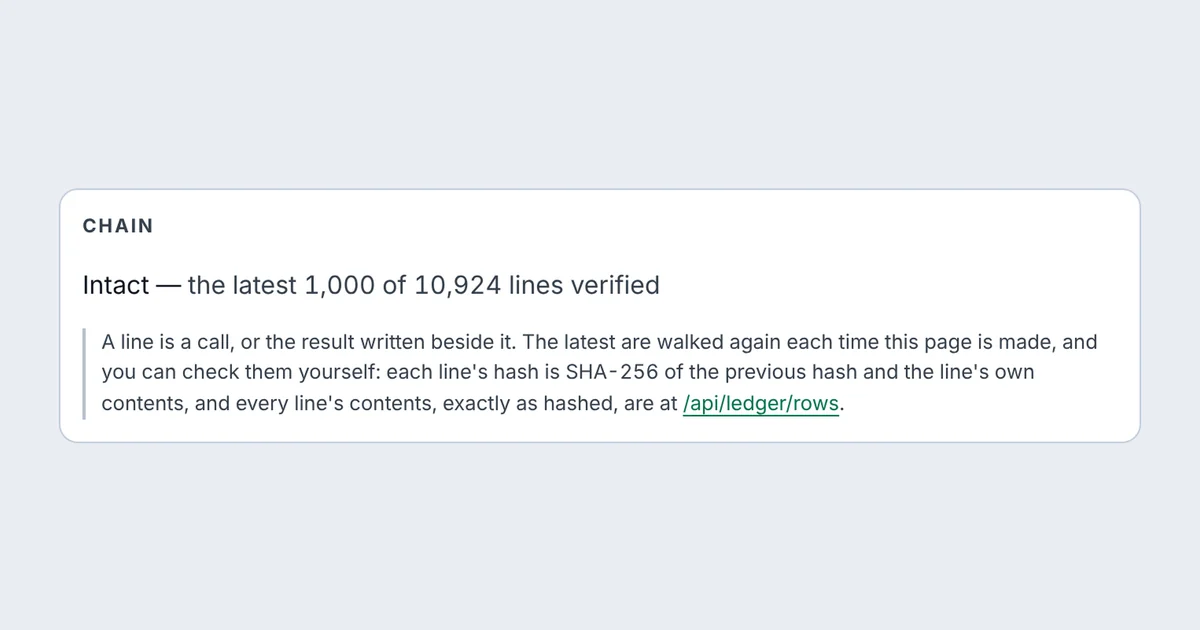
We ran that check on every line of the record on 9 November: all 10,924, from the first call on 24 September to that evening's. Every hash matched its contents, and every line pointed to the one before it. The record page re-walks the latest 1,000 lines each time it is made, and says so, as you can see in the picture above.
What the chain shows you
Because nothing can be quietly removed, the chain holds the things a cherry-picked record would leave out:
- Every loss. As of 9 November, 3,013 calls had come in and 2,297 had not. Those 5,310 lines are what the record's figures are worked out from.
- Every void. 128 calls on matches that were moved or not finished. Each has its result line, and none counts as a win or a loss. When the match doesn't happen explains the rule.
- A mistake from the first week. On 25 September, ten calls on Sudan v Ethiopia, an Africa Cup of Nations qualifier, went into the record at 14:48 UTC, after the match had kicked off. They were settled like any other at 16:30 (Sudan won 1–0, so eight lost and two came in), and that evening each was withdrawn with a third line of its own, kind 3: "Withdrawn: published after kick-off". None of the ten counts in any figure, the two that came in included. A call made after kick-off was never a forecast. But all thirty lines are still there, so you can see it happened.
What the chain can't show you
It's worth being straight about the limits.
A hash chain proves that nothing has changed since you, or anyone else, last saw it. It can't prove on its own that the very first version was honest. Someone determined could, in principle, build a fresh chain from scratch on day one. What stops that is people keeping copies. If you want certainty, save today's latest hash. If any earlier line were ever rewritten, the chain would no longer lead to the hash you kept, and you would have the proof.
The chain also says nothing about whether the calls are any good. That is a separate question, and the record answers it in the open: the market's prices have been more accurate than the Ghost's on the same calls, and the returns at a typical price are below zero. The chain just makes sure those numbers are built from what the Ghost actually said, when it said it.
SoccerGhost takes no bets and holds no money. It is for adults, 18 or over, and if betting stops being fun, help is here.